Projects
Creative Climate Action Projects taking place in Communities in Waterford.
KATE TWOHIG
Online Community
Building on the success of ACT 1 online video series Summer Call to Climate Action we wanted to continue our public engagement work around climate action in the digital space. For ACT 2, this work developed further through collaboration with online community manager Kate Twohig, with a particular focus on growing and strengthening Slí’s online audience. Together, the project expanded its digital reach and created new opportunities for engagement through online content, conversation and community-building. This strand focused on connecting with people where they already spend time, online, and creating a space for discussion around climate action, sustainability and everyday behavioural change. Through a combination of digital storytelling, social media engagement and audience development, the project sought to build a broader online community around ACT, encouraging participation, sharing of ideas and greater awareness of how individual choices can contribute to collective environmental change.
SPRAOI
Between Land & Sea
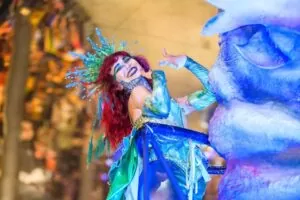
SPRAOI harnessed artistic, community, scientific and media resources to raise awareness of the “in-between” coastal zone linking landscape and sea at the Cunnigar in Dungarvan. The project explored the ecological richness and vulnerability of this unique shoreline environment, encouraging people to look more closely at the relationship between land, water, biodiversity and climate. A central creative element of the project was The Seaweed Girl, a striking visual figure inspired by the marine life and seaweed ecosystems of the coast. Through this character and wider artistic engagement activities, the project invited the community to reimagine their connection with the shoreline and to reflect on the environmental importance of coastal habitats. By bringing together artists, scientists, local participants and media, the project fostered greater awareness, curiosity and conversation around the Cunnigar’s natural and cultural significance.

Mollie Anna King
Reflecting the Past, Imagining the future
Artist Mollie Anna King devised and delivered a community engagement project titled Reflecting the Past, Imagining the Future in the Nire Valley and the village of Ballymacarbry. The project mapped the past, present and future of the area’s built and cultural heritage while exploring sustainable possibilities for its future development. The community was invited to imagine this future by rethinking the design and reuse of bothies and cluster villages, considering how these structures could be adapted within a modern and sustainable context for environmentally conscious tourism and contemporary living. Through the collection of stories, exploration of place names, and the development of proposals for the reuse of cluster villages and the remains of boolies, the project brought together local knowledge, heritage and sustainability. Activities included guided walks, workshops on hemp and sheep’s wool insulation, talks on traditional building methods, practical demonstrations, and discussions on renewable energy generation. Meitheal sessions invited community members to take part directly by trying out traditional building, insulating and powering methods, creating a hands-on shared exploration of how these spaces might be reimagined for the future.

JOANNE DONOHOE
Take the Bus for a Change
Building on the success of Joanne’s ACT 1 project, Joanne Donohoe devised and delivered a community engagement project focused on sustainable transport in Waterford City. The project aimed to encourage people to rethink everyday travel choices by promoting the idea of leaving the car at home and considering more sustainable forms of transport, in the spirit of caring for the Earth and reducing environmental impact. Working with community groups across the city, the project explored how walking, cycling, public transport and shared travel could become more accessible and attractive alternatives for local journeys. Through workshops, conversations and creative engagement with participants, the project examined the practical barriers people faced in changing travel habits, while also highlighting the personal, social and environmental benefits of more sustainable transport. It encouraged reflection on how small changes in everyday behaviour can contribute to broader climate action, healthier communities and a more connected city. By engaging directly with local communities, the project opened up conversations about mobility, accessibility, wellbeing and how we move through urban space in a more sustainable way.
SEAN CORCORAN
Consumerism
Artist Sean Corcoran devised and delivered a community mosaic engagement project in Waterford City focused on consumerism. Working with participants from the local community, the project explored patterns of consumption, waste, reuse and our relationship with everyday objects and materials. A central element of the project was “Crockery Mountain” — a large-scale sculptural installation created from discarded crockery, which invited reflection on overconsumption, food culture, and the environmental impact of waste. Through collaborative making and conversation, the project encouraged participants to think creatively about sustainability, reuse and more responsible forms of consumption.

Slí Waterford
Consumption and Recycling
In addition to working with four local communities, we also wanted to consider an online community investigating shopping and recycling habits. Working alongside the ACT Waterford team, Slí Waterford sought to identify the obstacles and impediments preventing young people (18–30) from taking action in relation to responsible consumption and recycling. While the majority of Irish citizens were concerned about the environment, a much smaller percentage took action on that concern. The aim of Slí’s contribution to the wider ACT Project was to produce a video series, Summer Call to Climate Action, to help people understand and overcome those impediments.
Rebecca Cappuccini
Greening the City
This “Greening the City” strand was led by a creative with a strong background in community gardens and citizen engagement, and was therefore ideally placed to work with this community. The greening of the city was informed by feedback provided by local and transdisciplinary audiences and communities. This community promoted planting in public spaces, gardens and balconies, and explored novel places to grow. An important aspect of the project was to inspire the community to begin using the Green again as a civic space.

Joanne Donohoe
Suburban Transport
Working with the Dunmore Road communities, creative Joanne Donohoe explored alternatives to everyday car journeys and encouraged people to consider taking the bus as a practical and sustainable alternative. Through conversations, shared experiences and local engagement, the project examined how small changes in travel behaviour could contribute to wider environmental action. By encouraging more sustainable transport choices, the initiative aimed to create a positive impact across the community — reducing reliance on cars, strengthening local connections and contributing to a healthier environment.
Kieran McBride
Biodiversity
All of the issues around biodiversity, habitat loss and sustainable agriculture were explored through the lens of water. To give the project an immediate focus, water and river systems became the central theme. The explorations began with local water and river systems and expanded to include their wider catchment areas. These included coastal areas, estuaries, lakes, streams, springs, bogs and peatlands, reed beds, fens, salt marshes, flood plains and wet alluvial woodlands. While increasing tree planting and expanding renewable energy sources were among the most widely recognised strategies for tackling climate change, the restoration of water and river systems was often overlooked in the public imagination. The project highlighted how restoring river systems and their habitats could drive change across an entire catchment area. River restoration was shown to contribute significantly to biodiversity and included approaches such as re-meandering waterways, creating natural green riverbanks, removing man-made obstructions to reopen habitats for migratory fish, planting trees to provide shade and reduce water temperatures, and restoring upland wetlands to increase water storage and help prevent flooding. The community selected for this strand was Kilmacthomas, and the creative appointed was Kieran McBride.

The Walls Project
Energy Use and Efficiency
Responding to the set theme, The Walls Project (TWP) worked collaboratively with the Ballybeg community to examine domestic energy use and efficiency. Particular attention was given to identifying real and achievable changes that the community could make to address climate change. TWP explored local issues within the Ballybeg community that affected people’s ability and willingness to take action. The multidisciplinary team, comprising artists, arts practitioners, engineers and scientists worked closely with the participating group to develop the brief for the artwork. The project took a practical approach to energy efficiency, focusing on the everyday actions people could take in their homes and daily lives to reduce energy use and make more sustainable choices.